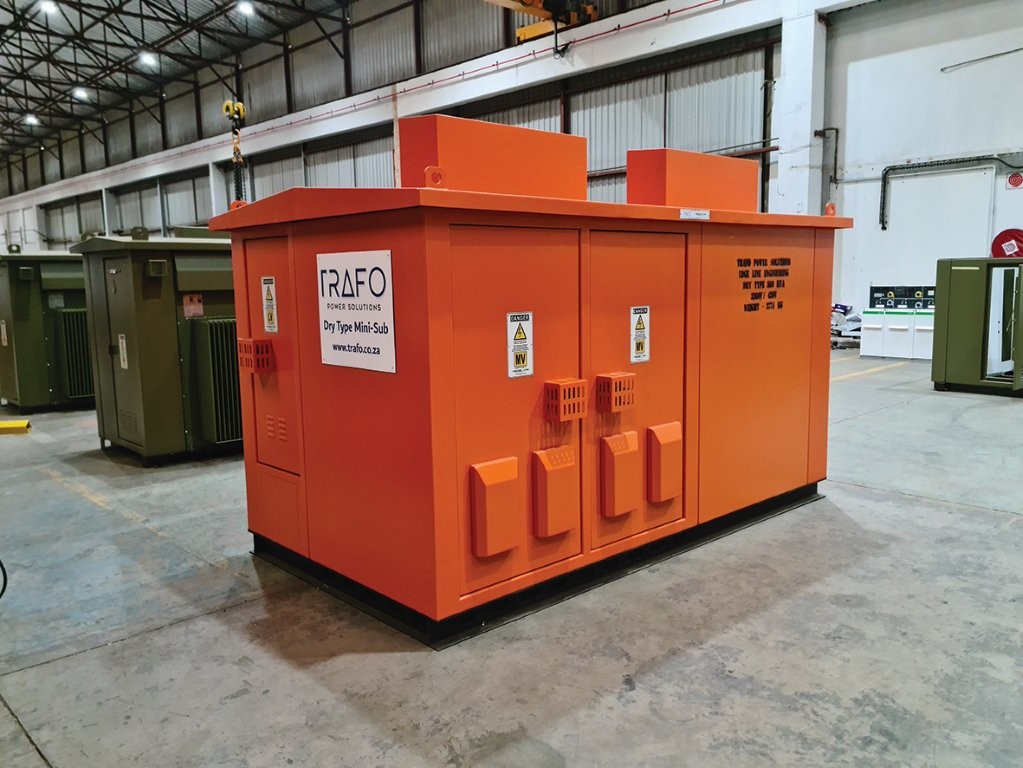
Space in urban areas is an increasingly scarce commodity. Commercial buildings are often innovatively designed to maximise this lack of space. Such buildings need transformers to distribute electricity throughout the building. Oil filled transformers, which have been used widely up to now, are often large, pose a fire risk and are not environmentally friendly. Construction World spoke to David Claassen, Managing Director of Trafo Power Solutions about dry-type transformers and its benefits for the construction industry.
Trafo Power Solutions (Trafo) is an industry-leading dry-type transformer supplier within sub-Saharan Africa. “Broadly speaking dry-type transformers is an alternative to oil filled transformers with the major benefit that the former poses no fire risk as it contains no oil.
In construction where safety and sustainability are key, such transformers are now preferred as a safer alternative, particularly when the building has large flows of public that places a premium on safety and use of space.
“In essence,” explains Claassen, “A transformer consists of two windings, the primary winding and the secondary winding. The primary winding is the coil that draws power from the source. The secondary winding is the coil that delivers the energy at the transformed or changed voltage to the load. A transformer is needed to step that voltage down to a usable voltage.”
In oil filled transformers the high and low voltage windings are fitted over a magnetic core. “This is placed in a tank filled with oil that acts as a cooling and insulating mechanism. The concept is exactly the same with dry-type transformers but instead of the windings and the magnetic core being placed in a tank and filled with oil, they are cast in resin. It is a completely sealed winding and the only medium to cool them with is air,” says Claassen.
“Normally oil filled transformers are installed in the basements of large buildings or outside the building. If installed in a basement it requires the necessary fire protection equipment which take up space. With dry-type transformers the need for fire protection is eliminated. In addition to being safer, dry-type transformers require far less maintenance than oil filled transformers and are more environmentally friendly,” says Claassen.
Competitive advantage
Trafo has an exclusive agreement with TMC Transformers (TMC), a company headquartered in Switzerland with manufacturing facilities in Italy. It specialises in the supply of medium and low voltage transformers. “This gives Trafo a competitive advantage as it is one of the largest manufacturers of dry-type transformers in the world and provides us with flexibility and manufacturing capability. We often have fast-tracked projects and our relationship with TMC in sub-Saharan Africa enables us to meet tight production schedules.”
Claassen explains that TMC has been in the dry-type transformer business for close to 40 years and has excellent experience with designing and manufacturing such transformers for a host of different environments. “It is a large exporting company and this knowledge gives us a competitive advantage,” Claassen explains.
“After an analysis of the client’s specific needs to ascertain the application, what the environmental conditions are and what the load will be, we put forward a design concept to TMC to design and manufacture the transformer. The enclosure around the transformer normally requires various customisations and are done locally,” says Claassen.
Benefits for the construction industry
“Due to rapid urbanisation, we see that developments such as offices and hotels are increasingly compact with smaller footprints in already built up areas. Oil filled transformers require that external substations or transformer bays are built outside the development, often in close proximity to heavy foot traffic. Such transformers are a risk as it can either short circuit due to lack of maintenance or due to a flaw in the electrical design, a situation exacerbated by its flammable tank of oil.”
With dry-type transformers existing space can be used such as basement areas or parking areas underneath the development. “We are able to install dry-type transformers in that environment without creating risks. Having flexibility in terms of where you install the transformer has safety benefits as it is closer to the load which reduces cable sizes and construction work,” Claassen explains.
According to Claassen the idea still exists that oil filled transformers are the cheaper option. “Depending on the substation layout, the pricing between oil filled and dry-type transformers is actually comparable. Because oil filled transformers was what the industry was familiar with, there was a preference for this. As safety, maintenance and environmental issues have gained importance, dry-type transformers are now preferred,” says Claassen.
An extended service offering
Trafo Power Solutions has extended its service offering to the built environment and is able to do an assessment of the existing substation layout (if an existing building needs to be fitted with a transformer), provide a report, safely remove the existing oil filled transformers, dispose of them in an environmentally friendly manner and in place install a new dry-type transformer.
“With the assessment,” says Claassen, “there are two scenarios. When it is a new building we will co-ordinate closely with the consultant or architect in terms of how the substation should be laid out for the best optimal cooling and practicality. Existing buildings that made use of oil filled transformers often want to improve sustainability in terms of environmental scores and safety. Trafo can get involved in assessing this existing building that has older substations with oil filled transformers and offer the service to remove the oil filled transformers on behalf of the client and safely dispose of them in environmentally correct ways. A dry-type transformer is then fitted into an existing substation layout. In most cases we are able to use existing cables and switchgear,” says Claassen. The report that Trafo provides following an assessment is detailed. “Trafo provides a drawing of the existing substation and deals in detail with aspects noted during the assessment, what we believe should be replaced, what should stay and what should be upgraded to help facilitate the objectives of replacing these transformers. We provide a complete risk assessment and method statement detailing how the transformers will be removed, how they will be disposed of how the dry-type transformers will be put into the substation with the least disruption,” Claassen concludes.